ZetaChain vs Axelar: A Developer Architecture Guide
Jul 3, 2026
ZetaChain Team
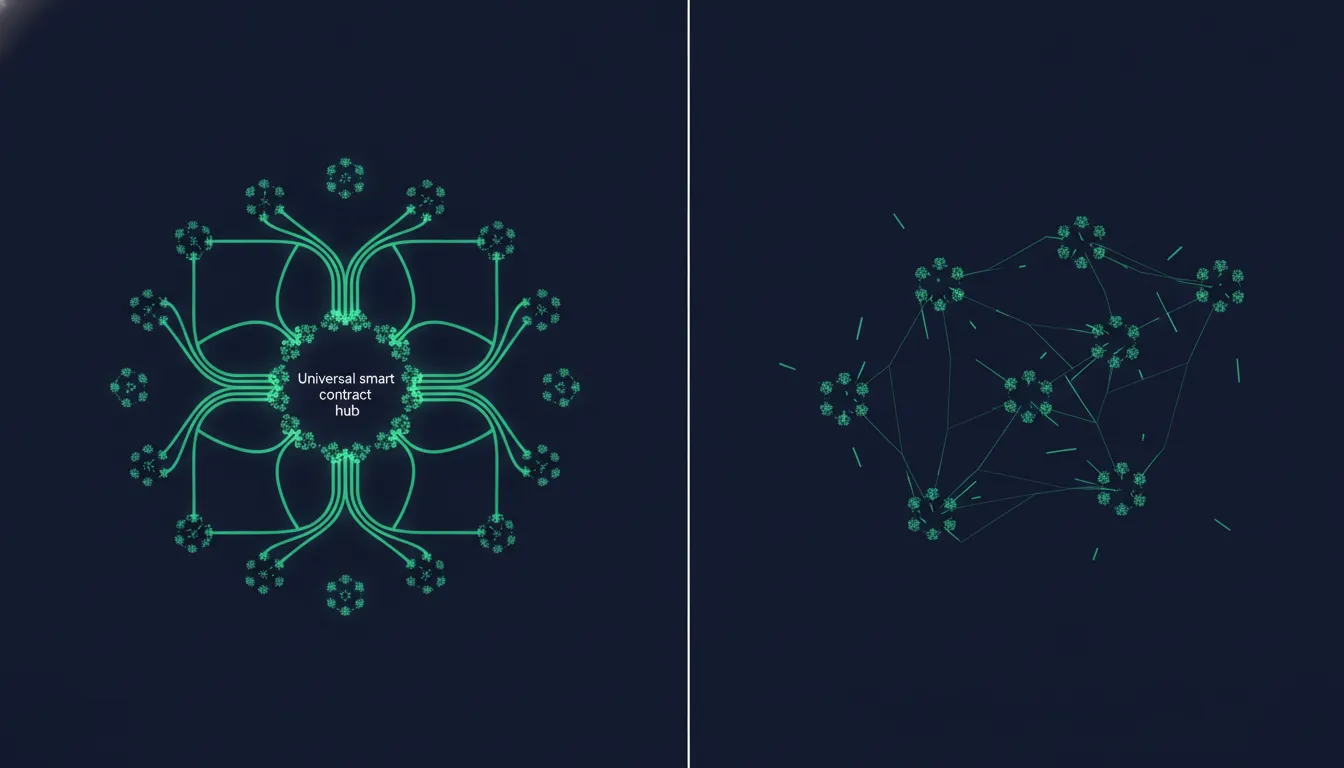
Choosing between interoperability architectures is not simply a matter of comparing network counts. The useful question is where your application logic should run, how state should be coordinated, and which failure modes your team is prepared to operate. For developers evaluating ZetaChain vs Axelar, that distinction leads to two different application designs. This guide turns that difference into a concrete architecture and prototype decision.
Start Building with ZetaChain documentation and test a Universal App against your real workflow.
ZetaChain provides a universal execution environment where a Universal App can coordinate assets and calls from connected networks through one smart contract. Axelar primarily provides infrastructure for passing messages between contracts deployed in different environments. Both approaches can connect applications and users, but they produce different contract topologies, operational responsibilities, and user experiences.
This guide focuses on those practical differences. It gives engineering teams a decision framework, security questions, and a prototype plan rather than treating the choice as a feature checklist.
ZetaChain vs Axelar: the architectural difference
The central difference is execution placement. With ZetaChain, developers can put shared application logic and state in a Universal App on ZetaChain. Users interact from connected networks, while the Universal App coordinates the workflow. With a message-passing architecture, developers commonly deploy and maintain application contracts in each target environment, then use messages to coordinate actions between them.
Decision area | ZetaChain approach | Axelar approach |
|---|---|---|
Primary abstraction. | Universal smart contract and shared execution. | Message transport between application contracts. |
Business logic. | Can be centralized in a Universal App. | Usually distributed across destination contracts. |
State design. | Shared state can live in one execution environment. | State coordination is designed across deployments. |
Developer focus. | Contract behavior, connected calls, and asset handling. | Message schemas, remote contracts, and delivery handling. |
Good first question. | Can one contract own the workflow? | Must logic execute in each destination environment? |
Neither abstraction eliminates distributed-systems work. Calls can fail, destination conditions can change, and applications still need explicit authorization, accounting, observability, and recovery policies. The architecture changes where teams express and operate those controls.
Where does application logic run?
Application logic runs either in a shared execution environment or across contracts deployed in destination environments. ZetaChain lets a Universal App own coordinating logic and state in one place. Axelar-style message coordination commonly keeps execution local, requiring teams to manage remote contracts, message formats, and distributed state.
Execution-centric design
A Universal App places the coordinating contract on ZetaChain. Instead of duplicating the full application across every connected environment, the team can encode core rules once and expose a consistent interaction model. This can be valuable for applications that need a unified account, portfolio, position, or policy across different networks. Developers can review the broader platform model in ZetaChain solutions.
Consider a portfolio application that accepts a user action from one network, updates shared allocation logic, and triggers an action involving an asset elsewhere. A Universal App can make the shared allocation state the center of the workflow. The developer still defines permissions, limits, and recovery behavior, but does not need a separate source of truth for each deployment.
Message-centric design
In a message-centric design, application contracts on separate networks exchange instructions. This is useful when the intended behavior truly must execute inside each destination environment. It also lets teams preserve existing destination contracts and add coordination around them.
The tradeoff is that the application owns more distributed state. Teams need to version message formats, authenticate senders, handle duplicate or delayed messages, and reason about partial completion. A successful send is not the same thing as a successful business outcome, so the destination contract must validate current conditions before acting.
A practical test
Draw the application as a state machine. If most transitions can be owned by one contract and connected interactions are inputs or outputs, universal execution deserves a prototype. If each destination must own distinct rules or state transitions, message-based coordination may be a more natural fit.
How each architecture changes the developer workflow
The architecture changes how many contracts, configurations, releases, tests, and operational controls a team must manage. Universal execution can concentrate core logic and invariants. Message-based coordination distributes responsibility across deployments and makes compatibility, delivery handling, and partial completion central engineering concerns.
Architecture becomes tangible in the repository, deployment pipeline, and incident runbook. Before selecting infrastructure, estimate the number of contracts, configuration objects, privileged roles, and release steps required for the smallest production workflow. Use the ZetaChain whitepaper alongside the documentation when evaluating protocol assumptions.
Contract topology and releases
With a Universal App, a team can often concentrate core logic into one contract system. That can reduce duplicated releases, but it also makes the Universal App an important coordination point that demands careful review and testing. Smart contracts may use upgradeable proxy patterns, so teams should document upgrade authority and safeguards rather than assuming all deployed code is strictly immutable.
A distributed deployment model introduces remote contract addresses, per-environment configuration, and compatibility requirements. Every message schema change may require coordinated releases. Teams need a policy for older senders, older receivers, and environments that cannot upgrade at the same time.
Testing and local reasoning
Universal execution can make core state transitions easier to test together. Engineers can focus on one set of invariants, then test connected inputs and outbound effects around that center. Message-based systems require strong contract-level tests plus integration tests for ordering, retries, authentication, and partial completion.
In either model, test adversarial paths. Simulate stale state, insufficient gas, paused contracts, unexpected callers, destination reverts, and repeated requests. Do not make a protocol-level assumption that every transaction is universally irreversible. Your application should define what finality it requires and how exceptions affect user-visible state.
Operations and observability
Operational dashboards should represent business workflows, not only transactions. Track the initiating action, each intermediate state, completion, and any compensating action under one correlation identifier. An operator should be able to answer what happened to a user request without manually searching multiple explorers.
A practical architecture decision framework
A sound ZetaChain vs Axelar decision starts with the application's state owner, required execution locations, failure paths, and operational surfaces. Teams should measure these factors with one representative prototype instead of selecting infrastructure from broad labels or network-count comparisons.
Define the state owner. List every state variable and decide which contract must be authoritative. If the answer repeatedly points to one shared application state, prototype a Universal App.
Map execution requirements. Identify actions that truly must run in a destination environment. Separate those from actions that are placed there only because of an inherited architecture.
Model failure paths. Write down what happens if a call is delayed, rejected, duplicated, or only partly completed. Specify retry, refund, timeout, and manual recovery policies.
Count operational surfaces. Estimate deployments, keys, roles, configurations, message schemas, monitoring rules, and emergency controls. Complexity should be measured, not assumed.
Evaluate security assumptions. Document protocol assumptions and application-level controls. Include authorization boundaries, upgrade authority, rate limits, and asset exposure.
Prototype one vertical slice. Build the smallest end-to-end user journey on test environments. Instrument every stage and compare implementation effort, latency, and recovery behavior.
Explore ZetaChain grants if your prototype needs ecosystem support.
This process prevents a common mistake: selecting an architecture from a broad label, then discovering that the application's state model does not fit it. The best comparison uses the actual workflow your team must ship.
What security assumptions should teams evaluate?
Teams should evaluate trust boundaries, authorization, upgrade controls, replay protection, ordering, partial completion, and economic exposure. Protocol infrastructure can authenticate or deliver an interaction, but application contracts still determine whether it is valid and how safely the workflow responds to failure.
Security analysis should separate protocol responsibilities from application responsibilities. Infrastructure can authenticate or deliver an interaction, but the application still decides whether the requested action is valid. Authorization, limits, accounting, and safe failure behavior remain developer concerns.
Trust and authorization boundaries
Document who can initiate each action and how the receiving contract recognizes that authority. Avoid treating a valid transport-level message as sufficient permission for every business operation. Validate the expected sender, source context, payload, nonce, and current application state.
Also inventory administrative controls. Many deployed protocols and applications retain admin keys, guardians, or governance mechanisms. Describe these controls precisely instead of broadly labeling a system fully decentralized. For upgradeable components, record who can upgrade them, whether a delay applies, and how users learn about changes.
Replay, ordering, and partial completion
Connected workflows can be asynchronous. Applications should be idempotent where possible, meaning repeated delivery does not repeat a harmful business effect. Store processed identifiers, validate sequence rules when ordering matters, and make timeout behavior explicit.
Partial completion deserves its own threat model. If one step succeeds and a later step fails, decide whether to retry, compensate, pause, or require operator review. A clear state machine is safer than attempting to hide intermediate states.
Economic limits
Set rate limits and exposure caps appropriate to the workflow. Monitor unusual value, frequency, destinations, and caller patterns. Emergency controls should be narrow, documented, and tested. The goal is not to claim zero trust; it is to understand each trust boundary and reduce the impact of failure.
Which architecture fits your application?
Universal execution fits applications that benefit from a shared source of truth and consistent workflow. Message-based coordination fits cases where logic must execute locally or preserve mature destination contracts. Some systems combine patterns, but authority and state ownership must remain explicit.
When universal execution is compelling
ZetaChain is a strong candidate when an application benefits from one source of truth and a consistent user-facing workflow. Examples include a universal account, unified liquidity logic, portfolio management, payments, and applications that need to coordinate assets including native Bitcoin. The design can let developers build core behavior once while serving users from connected environments.
This approach can also help when a team wants to minimize duplicated contracts and coordinated upgrades. The value is not merely fewer files. It is a simpler mental model for shared state and a narrower surface for core business logic.
When message-based coordination is compelling
A message-based approach fits applications whose logic is inherently local to destination environments or teams that must preserve mature contracts already deployed there. It can be appropriate when each deployment needs distinct rules, governance, or composability with local contracts.
That flexibility comes with engineering obligations. Treat remote contracts and message schemas as a distributed API. Maintain compatibility policies, explicit versioning, and robust observability. If the application cannot tolerate intermediate or divergent states, account for that constraint early.
When to combine patterns
Real systems can combine approaches. A Universal App may own shared policy while calling connected environments for specific effects. The important design choice is to keep authority and state ownership unambiguous. Hybrid does not have to mean unclear.
Developers can review the ZetaChain documentation to understand Universal Apps and connected contract patterns. The ZetaChain ecosystem also provides useful examples of what builders are shipping.
How to validate the choice with a prototype
Validate the choice by building one representative vertical slice, instrumenting every stage, and deliberately injecting failures. Compare contract count, configuration, privileged roles, recovery code, time to diagnosis, and user-visible outcomes. Evidence from the prototype is more useful than a generic feature checklist.
A prototype should test architecture risk, not polish. Choose one user journey that crosses a meaningful boundary and carries representative state. Define success criteria before coding so the team can compare results instead of defending its first implementation.
Build a vertical slice
Implement the smallest path from user intent to completed outcome. For ZetaChain, prototype the central Universal App state transition plus one connected input and one outbound action. For a message-based model, prototype the source contract, message payload, destination validation, and acknowledgement or recovery path.
Keep a decision log as you build. Count contract deployments, configuration values, privileged roles, SDK integrations, and custom recovery code. Record which parts of the workflow can be tested locally and which require full integration environments.
Inject failures deliberately
Do not validate only the happy path. Pause a destination component, reject an action, send a duplicate request, change a relevant state before completion, and simulate inadequate fees. Confirm that the user sees an accurate status and that operators have an actionable alert.
Measure time to diagnosis and time to recovery. A design that looks concise in a diagram may be expensive to operate when requests fail. Conversely, an architecture with a clear state owner can make recovery easier even when the underlying workflow remains asynchronous.
Review the result as a team
Bring application engineers, security reviewers, and operations owners into the prototype review. Compare implementation complexity, security boundaries, user experience, and ongoing release burden. Select the architecture that makes the required workflow safest and easiest to reason about, not the one with the longest feature list.
Frequently asked questions
These concise answers address the most common developer questions about ZetaChain vs Axelar, including the core architecture distinction, native Bitcoin support, and the best way to make a project-specific decision.
Is ZetaChain a bridge?
ZetaChain is a Layer 1 blockchain with a universal execution environment. Its Universal Apps can coordinate connected interactions and assets through smart contracts. Evaluating it only as a bridge misses the central developer abstraction: shared application logic and state.
Is Axelar the same type of architecture as ZetaChain?
No. Axelar is commonly used as message-passing infrastructure between application contracts, while ZetaChain supports universal smart contracts that can own shared logic and state. Developers should compare where execution happens and what their team must deploy and operate.
Can ZetaChain applications work with native Bitcoin?
ZetaChain is designed to support Universal Apps that interact with connected assets, including native Bitcoin. Teams should verify the current supported capabilities and implementation patterns in the documentation before defining production behavior.
How should developers choose between them?
Start with the application's state machine. Identify the authoritative state owner, required execution locations, failure behavior, and operational surfaces. Then prototype one representative workflow and compare complexity using evidence from the build.
Start building a Universal App
The fastest way to resolve the ZetaChain vs Axelar decision is to test your real workflow. Model the state owner, build one vertical slice, and measure the operational burden under failure. Review what builders are shipping across the ZetaChain ecosystem, then compare those patterns with your state model.
Start Building with ZetaChain documentation and prototype a Universal App.
Categories
Related Posts

ZetaChain vs Wormhole: A Developer Decision Guide
Start building after comparing zetachain vs wormhole across programming models, security assumptions, operations, and user experience.

Multi Model AI Routing Without Losing Context
Start building multi model AI routing that preserves context across providers with portable memory, secure retrieval, measurable policies, and resilient...