Bitcoin Programmability: Approaches, Limits, and Security Models
Jul 15, 2026
Lindsay S
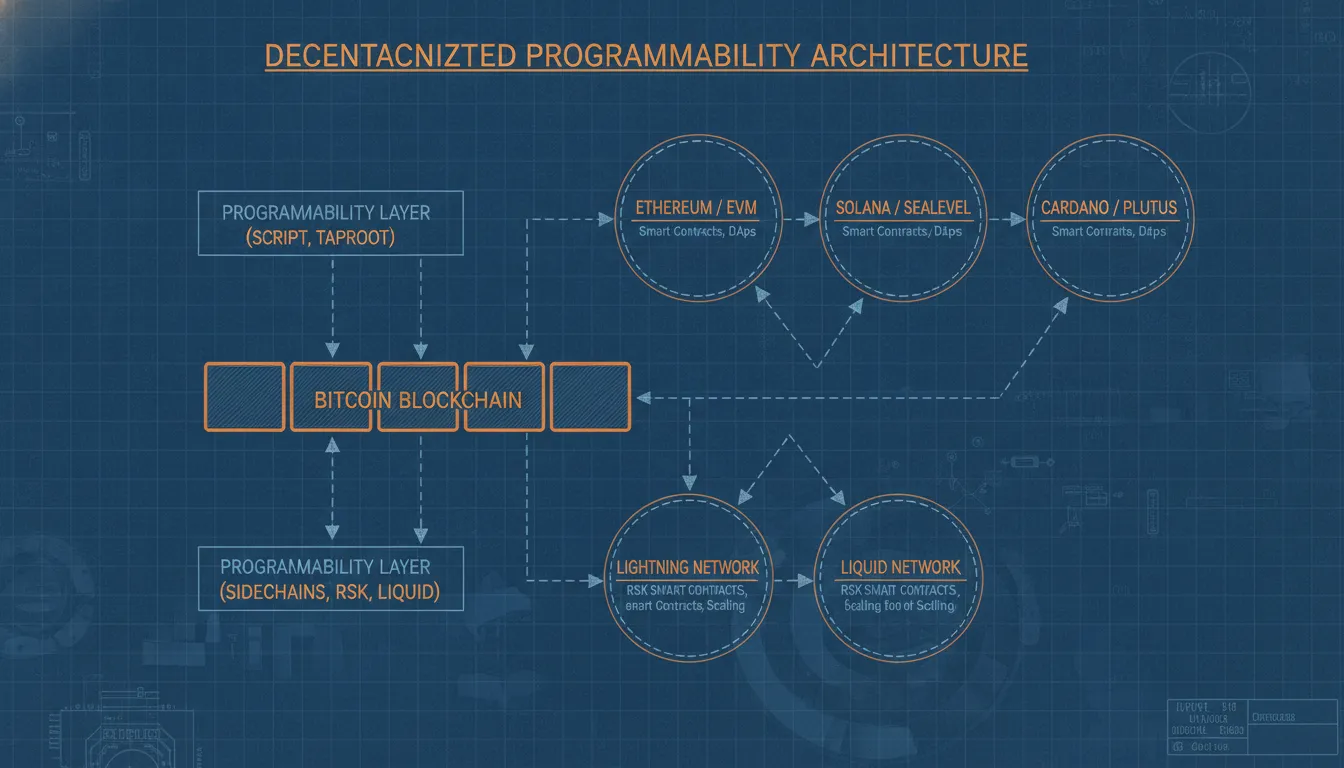
Bitcoin secures more than $1.2 trillion in market value but mostly functions as a passive store of wealth. Developers are now changing this by building new ways to execute complex logic directly with the network's native assets.
Bitcoin programmability is the technical ability to execute automated logic and smart contracts using Bitcoin's native assets and security. Approaches range from on-chain upgrades like Taproot to external execution layers that do not require changes to the core protocol.
This transition opens new possibilities for builders who want to use Bitcoin as more than digital gold. If you are evaluating these paths for your next project,
and explore which approach fits your architecture.
What Does the Bitcoin Programmability Landscape Look Like?
Bitcoin is an open-source money network that secures about $1T of value. Its original design prioritized security over complex computation, keeping the network safe and decentralized for over a decade. New tools now make it possible to build applications directly on this secure foundation.
The key approaches to bitcoin programmability include:
Native Layer 1 Script , Simple condition-based spending rules enforced by full network consensus, offering maximum security with minimal expressiveness.
Layer 2 networks (Lightning, BitVM) , Off-chain execution layers that use fraud proofs or payment channels to add functionality while keeping the base layer fast.
Sidechains (RSK, Stacks) , Independent blockchains with their own consensus that interoperate with Bitcoin through pegged assets.
External execution layers (ZetaChain) , Platforms that manage native BTC via threshold signatures, enabling full smart contract logic without bridges or wrapped tokens.
From script to Taproot
Early developers used Bitcoin Script to set rules for how funds could move. Script defines the conditions for spending funds, but it is limited by design. It does not support loops or highly complex logic, which helps prevent bugs that could jeopardize the network. This design keeps the base layer fast and lightweight.
The 2021 Taproot upgrade changed this trajectory. It introduced tools that made the network more private and easier to program. Taproot allows developers to hide complex scripts behind a single key, reducing the data needed per transaction and keeping costs low.
Layers of the Bitcoin ecosystem
The bitcoin programmability landscape has three main tiers. First, the base layer uses Script and emerging tools like covenants. These let developers set strict rules for how coins are spent over time, offering the highest security but the least flexibility for complex logic.
Second, Layer 2 solutions like the Lightning Network and BitVM add new capabilities. These tools scale Bitcoin by moving transactions off the main chain while preserving its security guarantees. Developers often turn to these layers when they want to bring smart contracts to Bitcoin. They use cryptographic proofs to verify that off-chain activity is valid.
Sovereign memory for AI
External execution layers provide the most freedom for builders. These systems run complex logic the base layer cannot handle alone. As the sovereign memory layer for AI, ZetaChain provides a way to manage persistent state across applications. It allows AI agents to maintain memory while staying connected to the secure Bitcoin network.
This model lets you build once and reach users on any network. You can use your BTC to power new applications without moving funds to a separate chain. This keeps your assets safe while giving you the freedom to build and grow across the Web3 ecosystem.
How Do Layer 1 Approaches to Bitcoin Programmability Work?
Bitcoin was not designed to run complex applications. Its core focuses on safety and value transfer. At its foundation, bitcoin programmability means encoding rules for fund movement using Bitcoin Script. This language is not Turing-complete, meaning it cannot execute loops or arbitrary computation.
The limits of Bitcoin Script
Most base-layer payments use Pay-to-Pubkey-Hash (P2PKH), where the blockchain hides the public key until the user spends the funds. This keeps the network secure but limits what builders can create. Without the ability to store complex state, Bitcoin Script remains a tool for basic lock-and-key logic. Making the network stable but unable to run the types of applications found on other platforms.
Taproot and Schnorr signatures
The 2021 Taproot upgrade brought new tools that made the network more private and easier to program. It introduced Schnorr signatures, which allow multiple parties to sign a single transaction together. The network sees a simple spend, but the transaction can embed complex logic. This helps groups transact without revealing how many participants are involved.
Taproot also enabled Merkle Abstract Syntax Trees (MAST). MAST lets builders create multiple spending paths for a single UTXO. Only the executed path is revealed on chain, saving space and keeping other conditions private. For example, a user could have one path for a normal spend and a backup path for recovery. While significant, this still does not match the full programmability of a general-purpose smart contract environment. Builders continue looking for ways to bring smart contracts to Bitcoin without losing its core security.
Covenants and future upgrades
Emerging proposals like covenants aim to give Bitcoin more expressive power. A covenant is a rule that constrains where funds can go in subsequent transactions. Proposals such as CheckTemplateVerify (CTV) and AnyPrevOut (APO) are still under discussion. These tools would enable vaults, where a user can reverse a stolen payment within a defined timeout, adding a new safety layer for large holders.
These Layer 1 approaches preserve Bitcoin's trust model. Every rule is validated by every node in the network, meaning any new code must be safe enough for the entire system to adopt. The trade-off is clear: adding features to the base layer is slow and difficult to change. For many builders, the optimal path keeps the base layer simple while moving complex applications to higher layers.
Layer 2 and Sidechain Solutions
Developers expand bitcoin programmability with off-chain tools and sidechain networks. These systems move complex logic to other layers, enabling fast applications that do not congest the base blocks. These L2 and sidechain solutions help transform Bitcoin from a passive store of value into a productive asset.
Payment and state channels
The Lightning Network is the most established scaling tool for Bitcoin. It uses payment channels so two parties can transact many times without recording every movement on the main chain. This lowers fees and enables near-instant settlement. BitVM extends this model by using fraud proofs to enforce complex contract logic. Anyone can challenge a dishonest claim on the main chain, which helps define the role of Bitcoin L2s in the growing ecosystem.
Programmable sidechains
Sidechains like RSK and Stacks provide full smart contract environments that run alongside Bitcoin. RSK uses merge-mining, where Bitcoin miners secure the sidechain while mining the main chain. Stacks uses a proof-of-transfer mechanism that earns native BTC by locking tokens, and it uses Clarity, a decidable language designed to help avoid bugs. These layers make it easier to bring smart contracts to Bitcoin without modifying its core protocol.
Trust models and peg security
Each system uses a different trust model to secure funds. Fraud-proof systems like BitVM assume at least one honest participant will challenge invalid state transitions. Sidechains rely on a federation or their own validator set to manage the peg bridge. These cryptographic mechanisms are essential for making Bitcoin more useful for applications. Choosing the right model depends on how much speed a builder needs versus how much trust they place in the secondary layer. These trade-offs directly impact Bitcoin development freedom for new applications.
Security Models for Bitcoin Programmability
Bitcoin security relies on a distributed network of miners and protocol rules. Because there is no central authority, safety depends on the software and the people who run it. Adding new programmability paths changes how users trust the system. Each approach shifts the balance between base-layer safety and expressive power.
Building applications for Bitcoin requires evaluating how funds are held and managed. In some models, users retain self-custody. In others, a group of validators or a separate chain governs the assets. The speed at which funds can be withdrawn also varies. Some systems allow fast exit, while others impose challenge periods or confirmation delays. These factors directly inform the decision to bring smart contracts to Bitcoin.
Trust and custody trade-offs
Security for Bitcoin applications depends on where the logic executes and who controls the assets. Different layers offer distinct approaches to risk and speed. Developers must weigh base-layer safety against the capabilities of new tools.
Optimistic and script-based models
Bitcoin Script uses simple predicates to set spending conditions. It is the most secure option because the main network validates every step, but it is limited in expressiveness. Lightning takes a different path by keeping most activity off-chain. It uses watchtowers to detect cheating, introducing a new trust assumption: if no watchtower monitors the network, funds could be lost during a channel close.
BitVM introduces a fraud-proof model that assumes honest behavior unless proven otherwise. If a participant attempts to cheat, a proof is submitted to the main chain to revert the invalid state. This enables more complex applications than raw Script, but it requires waiting through a challenge window before finalizing a transaction. This delay is a direct trade-off for greater expressive power.
Universal application security
Sidechains like Stacks and RSK maintain their own security budgets through independent validator sets and consensus mechanisms. This gives builders substantial freedom, but it means trusting a new set of validators. If the sidechain experiences a failure or reorganization, bridged Bitcoin could be at risk. This concern drives many developers toward approaches that stay closer to Bitcoin's native security model.
ZetaChain uses a threshold signature scheme (TSS) to manage Bitcoin programmability. This method allows the platform to sign transactions without a central authority. A distributed set of observers and signers tracks the state of the Bitcoin network. This preserves Bitcoin protocol security while enabling full smart contract execution. Builders use this to create cross-ecosystem applications that work with native BTC, no wrapping required.
Which Bitcoin Programmability Approach Is Right for Your Project?
Selecting a development path depends on your specific project goals and technical requirements. While bitcoin programmability was once limited to basic scripts, developers now choose between several distinct layers. You must balance security guarantees against the need for complex logic and rapid deployment.
Evaluating security and expressiveness
Security is the primary factor for any Bitcoin project. Native Layer 1 scripts offer the highest safety but provide the least flexibility for complex applications. Layer 2 networks and sidechains expand what you can build, yet they introduce new trust assumptions or require independent security budgets. Developers must decide whether their application needs full Bitcoin consensus or whether a secondary execution layer fits their use case better.
Expressiveness determines how much logic your smart contracts can handle. If you need full Solidity support to reach a broader user base, an external execution layer is often the best choice. This path provides Bitcoin development freedom without the constraints of native Bitcoin Script. You can build advanced features like decentralized exchanges or lending protocols that native scripts cannot support.
Speed and ecosystem support
Time to market is critical in a fast-moving industry. Building directly on the base layer involves long development cycles and deep knowledge of low-level code. Using an environment that supports existing tools helps you ship faster. Modern platforms allow you to use familiar languages like Solidity to manage native BTC. This lets you focus on your product rather than the complex details of the underlying chain.
Ecosystem support also matters. Platforms with active grant programs, developer documentation, and community resources accelerate development. The role of Bitcoin L2s in providing these resources continues to grow as more developers enter the space. Before committing to a specific approach, evaluate the available developer tooling, documentation quality, and community activity.
ZetaChain Approach to Bitcoin Programmability
ZetaChain offers a distinctive approach to adding programmability to Bitcoin. Most alternatives use wrapped tokens or bridges to transfer value, which can introduce latency, complexity, and additional attack surfaces. ZetaChain uses a different architecture. It lets developers write smart contracts that interact with native Bitcoin directly, eliminating the need to swap BTC for a representation on another chain. This is a key part of the role of Bitcoin L2s and the broader scaling ecosystem.
Threshold signatures for native BTC
The system uses a Threshold Signature Scheme (TSS) to manage Bitcoin assets. This technology lets the platform sign and settle real Bitcoin transactions without a central operator or single point of failure. TSS signers produce valid Bitcoin transactions coordinated through a distributed protocol. Since the approach operates directly with the base layer, no bridge infrastructure is required. This design eliminates the centralized failure risk that plagues many cross-chain bridge architectures. This matters because Bitcoin is an open network that secures massive value through decentralized participation.
The platform uses a three-component architecture: ZetaCore, Observers, and TSS Signers. Observers monitor the Bitcoin chain for relevant events. When predefined conditions are met, the TSS Signers construct and broadcast the corresponding Bitcoin transaction. This setup enables smooth cross-network interactions. Teams can build applications that interact with Bitcoin as if it had native smart contract support, a significant advancement for bitcoin programmability that preserves the security guarantees of the underlying chain.
The zEVM and Solidity support
The platform includes the zEVM, a smart contract execution environment compatible with Solidity, the most widely used language for blockchain applications. Because zEVM works with existing Solidity tooling, teams can use familiar development frameworks, libraries, and deployment pipelines. A single application deployed once can reach Bitcoin and multiple other networks simultaneously. This eliminates the need to build and maintain separate codebases for each blockchain.
Building on the zEVM lets you bring smart contracts to Bitcoin with significantly less overhead. Applications remain in one place while operating across ecosystems. This helps you reach more users and simplifies monetization through unified liquidity. Developers find this path efficient because they can focus on application logic rather than the complexities of cross-chain asset movement.
Building the Bitcoin ecosystem
ZetaChain supports ecosystem growth through a grants program that allocates resources to new projects building on Bitcoin. Five percent of the total ZETA supply is reserved for this initiative, representing over 5 million dollars in funding. The majority of this pool goes to teams building tools for Bitcoin programmability, including decentralized lending, gaming, and social applications that leverage native BTC.
By developing on this platform, teams can ship faster with native Bitcoin access and broad network reach. Users keep their BTC in native form while using it in new ways. Builders reach more users without requiring a large team. These capabilities help transform Bitcoin from a store of value into a live platform for decentralized applications , the core mission of the ZetaChain approach to bitcoin programmability.
Frequently Asked Questions
What is bitcoin programmability?
Bitcoin programmability refers to the ability to execute automated logic and smart contracts using Bitcoin's native assets and security. While the base protocol uses a limited scripting language called Script, newer approaches such as Taproot. Layer 2 networks, sidechains, and external execution layers expand what developers can build with BTC.
How does Taproot improve Bitcoin programmability?
Taproot, activated in 2021, introduced Schnorr signatures and Merkle Abstract Syntax Trees (MAST). Schnorr signatures allow multiple parties to sign a single transaction as one, improving privacy and reducing data. MAST enables multiple spending conditions for a single UTXO, where only the executed condition is revealed on-chain. These upgrades make Bitcoin more programmable while preserving its security and privacy properties.
What is the difference between Bitcoin L2s and sidechains?
Bitcoin Layer 2 solutions like the Lightning Network and BitVM process transactions off-chain and use the main chain only for settlement or dispute resolution. Sidechains like RSK and Stacks are independent blockchains with their own consensus mechanisms that interoperate with Bitcoin through pegged assets. L2s inherit Bitcoin's security more directly, while sidechains offer greater flexibility but introduce additional trust assumptions through their bridge infrastructure.
Can you use Solidity to build on Bitcoin?
Yes, through external execution layers like ZetaChain that support the Ethereum Virtual Machine (EVM) and Solidity. ZetaChain uses a threshold signature scheme to manage native BTC, allowing developers to write smart contracts in Solidity that directly control Bitcoin transactions. This means existing Solidity developers can build for Bitcoin using familiar tools without learning a new language or deploying wrapped tokens.
How does ZetaChain handle Bitcoin programmability?
ZetaChain uses a Threshold Signature Scheme (TSS) to sign and settle native Bitcoin transactions without bridges or wrapped tokens. A distributed set of Observers monitors the Bitcoin chain, and TSS Signers produce valid Bitcoin transactions when smart contract conditions are met. The zEVM execution environment supports Solidity, enabling developers to build applications that directly control native BTC while staying connected to other blockchain networks.
What are the security risks of Bitcoin programmability?
Each approach introduces different security considerations. Native Script carries the lowest risk because every condition is validated by full network consensus. Layer 2 systems introduce watchtower or fraud-proof dependencies. Sidechains rely on separate validator sets and bridge infrastructure, which have historically been targets for attacks. Threshold signature approaches distribute control across multiple signers, eliminating single points of failure but requiring careful key management and observer network liveness.
Ready to build on the world's first programmable Bitcoin layer?
Bitcoin programmability is evolving rapidly. Whether you are building a DeFi protocol, an AI application with persistent memory. Or a cross-ecosystem dApp, choosing the right approach determines your security model, development velocity, and user reach. ZetaChain's native BTC integration via threshold signatures provides a path that combines Bitcoin's security with full Solidity smart contract support.
Start Building with bitcoin programmability and join a growing ecosystem of developers creating the next generation of Bitcoin-powered applications. Explore the documentation, review the grants program, and deploy your first smart contract on the sovereign memory layer for AI today.
Categories
Related Posts

Multi Model AI Routing Without Losing Context
Start building multi model AI routing that preserves context across providers with portable memory, secure retrieval, measurable policies, and resilient...

Persistent AI Memory: Production Architecture Patterns
Start building persistent AI memory for production apps with practical patterns for safe writes, precise retrieval, user control, testing, and portability.